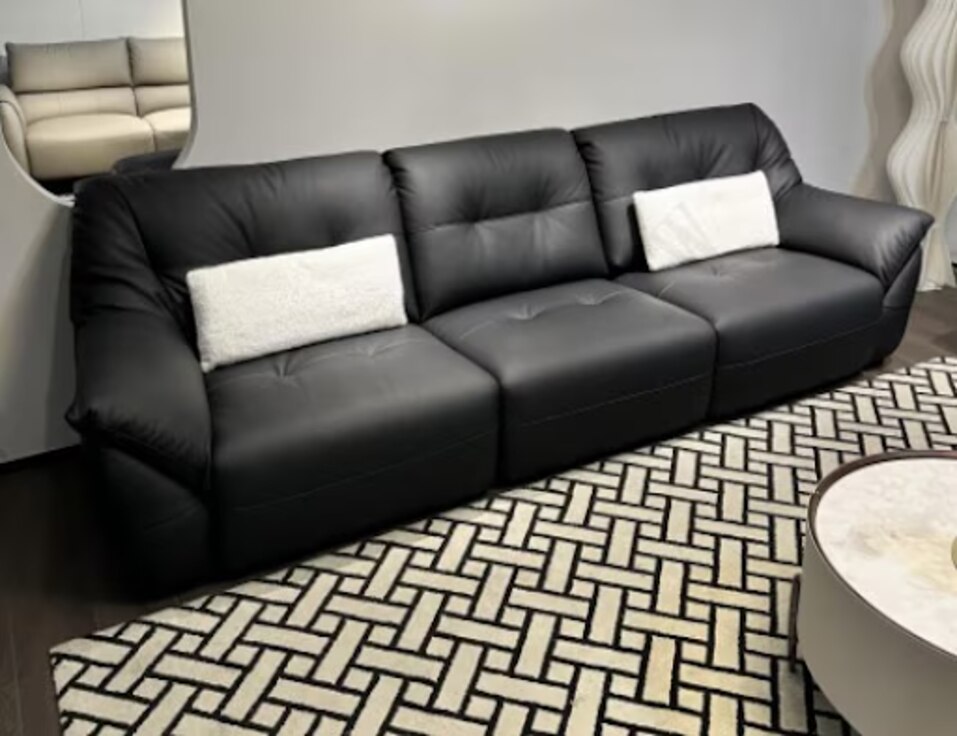
A reception sofa has to fit the building, withstand repeated public use, and support the way visitors actually wait and talk. By the end, you will have a site-measurement checklist, a seating-density method, and a supplier scorecard for comparing Manesar manufacturers with vendors across the wider Delhi NCR market.
Key takeaways
- Verify the factory, production control, and defect-resolution process before comparing prices.
- Measure doors, lifts, corridors, and turns before approving sofa dimensions.
- Choose seating density and layout for actual visitor demand, not showroom appearance.
- Test upholstery samples and record warranty terms in a supplier scorecard.
Verify the Manesar supplier before comparing quotations
A usable sofa manufacturer in Manesar can show you where production happens, who controls the specification, and how defects are resolved after delivery. A trading address cannot answer those questions.
1. Check the Manesar showroom address and factory address independently. Visit the site, confirm its signboard and production activity, and ask to see cutting, stitching, frame assembly, upholstery, inspection, and packing areas.
2. Request a written production and service contact, delivery lead time, installation responsibility, replacement process, and escalation route. A quotation without an accountable project contact is a supply risk.
3. Ask for test methods and load-cycle results, not only “commercial grade.” For non-domestic seating, request the applicable EN 16139 use level or BIFMA X5.4 evidence. EN 1728 covers strength and durability methods; EN 1022 covers stability, but neither is a complete sofa specification.
4. Separate indoor-air-quality evidence from structural testing. Ask for ANSI/BIFMA M7.1 and X7.1 emissions documentation when the project requires it.
5. Tie the approved sample to a bill of materials covering frame sections, suspension, foam density and firmness, fabric lot, seams, legs, dimensions, and tolerances. Otherwise, substitutions can appear after approval.
Use the same checklist in a Gurugram furniture supplier comparison, then compare factory access, response time, documentation, replacement capability, and delivered cost rather than quotation price alone.
Measure the access route and specify the sofa’s usable dimensions
Collect the room layout and the complete delivery path before requesting a quotation. A sofa that fits the plan can still fail at the entrance, lift, corridor turn, or stair landing.
- Record the room’s finished length and width, finished-floor-to-ceiling height, column locations, wall recesses, skirting depth, power points, and the sofa’s required clearance from walls.
- Mark the reception queue, desk edges, tables, doors, and walking routes. Keep the planned passage clear around seating rather than measuring an empty room.
- Take door and lift measurements: clear opening width and height, lift-car width, depth and height, door swing, threshold height, and the diagonal clearance available while turning.
- Measure corridor widths, every corner’s turning radius, stair widths, landing size, handrail intrusions, and changes between finished-floor levels. Draw the intended assembly route from unloading point to final position.
- Specify reception sofa dimensions as overall width, depth, height, number of seats, sofa seat height, sofa seat depth, arm height, back height, and leg or plinth clearance. State permitted dimensional tolerances.
Choose the construction against the route, not only the floor plan:
| Option | Access implication | Trade-off |
|---|---|---|
| One-piece sofa | Needs clearance at every opening and turn | Strong visual continuity, difficult replacement |
| Modular or knock-down sofa | Sections pass through smaller openings and assemble inside | More joints, but easier installation and future replacement |
Ask the manufacturer to confirm packed-section dimensions, assembly space, and whether quoted dimensions describe the finished sofa or its shipping package.
Match seating type and seat density to visitor demand
Base office reception seating capacity on the number of visitors waiting at one time, not the daily headcount. Count seats around reception queues, coffee tables, columns and door swings; an oversized sofa that blocks circulation wastes more floor area than a smaller, distributed arrangement.
| Option | Best use | Floor-area trade-off |
|---|---|---|
| Two-seater sofa | Low, predictable demand; pairs or short visits | Easier to place between doors and corners than a larger unit |
| Three-seater sofa | Higher demand in a straight wall zone | Adds capacity efficiently but needs a longer clear wall and deeper turning space |
| Modular sectional sofa | Variable demand, corners or changing layouts | Uses awkward corners well; specify connectors, alignment and anti-tip control |
| Bench | Short waits and dense, orderly queues | High seat density, but offers less privacy and individual comfort |
| Lounge chairs | Visitors needing separation, accessibility or flexible movement | Easier to reposition, though several chairs consume more circulation space |
| Banquette | Fixed wall runs, alcoves and built-in reception zones | Maximises perimeter seating but cannot adapt when the room layout changes |
Choose separate sofas or chairs when visitors arrive in small groups and leave at different times. Choose a modular sectional sofa when demand fluctuates or the room has an unusable corner; verify that joined units do not creep apart on smooth flooring.
Specify EN 16139 for non-domestic seating, or BIFMA X5.4 where appropriate; do not treat their test regimes as equivalent. A structural test report does not prove VOC compliance under ANSI/BIFMA M7.1 and X7.1.
Compare upholstery, comfort, and commercial-use performance
A sofa that feels soft in a showroom can bottom out after months of queue traffic. Request the foam grade and thickness, cushion support, reversibility, separate wrap, and cover-retention method; a thin foam layer over a soft substrate is not equivalent to a thicker, properly supported cushion.
Material choice changes both maintenance and failure risk.
| Material | Advantages | Checks before approval |
|---|---|---|
| Leatherette versus genuine leather | Leatherette offers predictable cleaning and lower replacement cost; genuine leather can age well but needs conditioning | Test the proposed cleaner, inspect seam strength, and confirm repair or panel replacement |
| Woven fabric upholstery | Comfortable, breathable and available in many patterns | Request the Martindale or Wyzenbeek method, fabric construction, test endpoint and result; do not convert one method into the other |
| Polyester upholstery | Practical colour and pattern choice for busy interiors | Check colourfastness, seam slippage, stain-cleaning instructions and disinfectant resistance |
| Vinyl sofa upholstery | Wipe-clean surface suited to spills and frequent disinfection | Test the actual chemicals, inspect welded or stitched seams, and check cracking and finish deterioration |
Specify EN 16139 for non-domestic seating or BIFMA X5.4 for lounge and public-use seating; their test regimes are not interchangeable. Ask for separate evidence covering:
- Frame, suspension, foam, mechanism, upholstery, stitching and glide coverage in the warranty.
- Response times, spare parts, replacement covers and replacement cushions.
- VOC documentation to ANSI/BIFMA M7.1 and X7.1 when indoor-air-quality requirements apply.
A structural test report does not prove cleanability, emissions compliance or long-term seam performance.
Use a controlled sample, documented warranty, and supplier scorecard
Do not award on the lowest quotation. Approve one physical sample, then freeze its bill of materials before comparing Manesar, Noida, Gurugram, and Delhi suppliers.
Record the frame material and section sizes, suspension, foam density and thickness, upholstery fabric lot or approved equivalent, thread, seam construction, legs, glides, dimensions, and permitted tolerances. The quotation must state that substitutions require written approval. Kantoor Furniture By 360 Degree Interiors can be assessed on this same evidence rather than on catalogue language.
Request test reports showing the actual methods and load cycles. EN 16139 covers non-domestic seating strength, durability, and safety; BIFMA X5.4 is another relevant lounge-seating reference, but do not treat it as automatically equivalent. Ask whether EN 1728 strength and durability methods and EN 1022 stability testing were used.
A structural report does not establish VOC emissions office furniture compliance: request ANSI/BIFMA M7.1 and X7.1 documentation separately.
Score each supplier against these commercial terms:
- A component-by-component commercial sofa warranty for frame, suspension, foam, mechanism, upholstery, stitching, and glides.
- Written response times, site-service coverage, spare-part availability, and a cushion or cover replacement process.
- A delivery date, installation scope, packaging-removal responsibility, damage-claim window, payment milestones, and taxes stated in the offer.
- Fire-test documents identifying the exact fabric, filling, specimen build-up, and test scope; TB117-2013 alone does not prove BS 5852 or EN 1021 compliance.
Choose the supplier with the strongest documented score, not the shortest route.
Related product
 | Sofa Series Sofa by Kantoor Furniture is a premium seating solution designed to provide exceptional comfort, style, and durability for offices, reception areas,... |
Frequently asked questions
How can you verify a sofa manufacturer in Manesar?
Inspect where production happens, identify who controls the specification, and ask how the supplier handles defects after delivery. Compare a real manufacturing operation with a trading address that cannot answer those questions.
What access measurements should you take before ordering office sofas?
Measure entrance doors, lift interiors and doors, corridor widths, stair landings, and every turning point. Give the manufacturer the sofa’s overall width, depth, height, and usable seating dimensions.
How should you choose sofa seating for reception and lounge demand?
Match the seating type and seat density to expected visitor volume, waiting time, and available floor area. Select configurations that support the way people use the space rather than choosing only by appearance.
What should you compare between commercial sofa suppliers?
Compare upholstery performance, comfort, construction, controlled samples, documented warranty coverage, defect resolution, and delivery performance. Record each result in a supplier scorecard before selecting a quotation.