A two-seater label tells you how many pupils a desk is intended to serve, not whether both pupils will have adequate writing space, knee clearance or a safe route to their seats. Use student stature, room geometry and the lesson format to define the specification before comparing School Dual Desks Sonipat suppliers.
Key takeaways
- Match desks to student height and popliteal height, not age alone.
- Request tabletop, seat, knee-clearance and overall footprint measurements.
- Count seats from usable floor area after aisles, walls and teacher space.
- Check samples, dimensions and installation details before placing a bulk order.
Start With Student Stature, Not the Two-Seater Label
Choose the desk from the students’ stature range, not from a “two-seater” or age label. Age is only a starting point: measure student height and popliteal height, the floor-to-knee measurement, to check whether feet rest on the floor and knees fit below the tabletop.
Ask for the EN 1729-1 size mark or a stated stature range. Reject descriptions such as “primary” or “senior” unless the supplier gives dimensions.
- Size marks pair approximately as follows: 210 mm seat with 400 mm table; 260 with 460; 310 with 530; 350 with 590; 380 with 640; 430 with 710; and 460 with 760.
- Primary pupils need supported feet, a seat shallow enough to reach the backrest, and a table that does not force raised shoulders.
- Secondary students need sufficient seat depth for thigh support and clear knee space beneath the apron.
- Adult coaching classes need the largest suitable range, writing clearance, and enough thigh room for prolonged sessions.
Seat height alone does not prove fit. Check seat depth, backrest position, backrest angle and table height together: a deep seat leaves a small pupil unsupported, while a tall pupil hits the apron with the thighs or knees.
For mixed-height classrooms, specify multiple size marks or adjustable frames instead of one universal model. This is a core School Seating Sonipat check, not a finishing detail.
Ask for Every Dimension That Controls Usable Seating
Before comparing quotations from a Dual Desk Manufacturer in Sonipat, demand a dimensioned drawing and mark every figure as a clear internal dimension or an outside dimension. A “two-seater” label proves only that the top is wide enough on paper; it does not prove two pupils can write elbow-to-elbow or move their knees.
Ask for these measurements for Student Desk Furniture Sonipat projects:
- Overall width and depth; clear width for each seating position.
- Tabletop height; seat height, width and depth.
- Backrest height, angle and edge treatment.
- Legroom; under-desk knee and foot clearance.
- Apron thickness and centre-frame intrusion.
- Book-rack width, depth and height.
Separate tabletop depth from usable writing depth after a rear upstand, storage box or divider is fitted. A full-width book rack can trap feet; a centre pedestal can block one knee; insufficient clear width can turn two seats into one comfortable position and one compromised position.
| Measurement | Why it matters | What to verify |
|---|---|---|
| Tabletop depth | Shows the surface available for books and writing | Deduct the rear upstand, box or divider |
| Knee clearance | Shows whether thighs and knees fit beneath the top | Include apron and centre-frame intrusion |
| Book-rack size | Shows storage capacity and foot obstruction | State both storage volume and clear foot zone |
Use the ADA table benchmark of 760 mm minimum knee width, 685 mm knee height and 485 mm knee depth as a reference point, then confirm Indian institutional and accessibility requirements. Accessibility also requires an unobstructed approach, not merely a compliant-looking desk.
Calculate Seats From the Usable Classroom Footprint
Do not divide total floor area by desk area: that calculation counts seats that door swings, chairs, bags and teaching space make unusable. Calculate from the usable footprint after removing the teacher zone, door-swing arc, window access, columns, fixed cupboards and wall sections that cannot accept furniture.
For a School Dual Desks Sonipat project, require a scaled plan before approving the count. Draw the desk footprint, chair pull-out space, front-facing rows, row-to-row aisles, a clear route from the entrance to the front and emergency exit, and at least one accessible position with a usable approach.
- Measure the room’s finished internal length and width, then mark every permanent obstruction.
- Test each desk with two complete seating positions, including knee clearance, foot clearance and chair movement.
- Reserve teaching space at the front before placing the first row.
- Show window-opening clearance, door operation and the route to the accessible position.
- Mark bags and storage on the plan; an open shelf can push them into an aisle.
Front-facing teaching needs orderly rows and direct sightlines. Examination layouts need extra separation and writing space; group work needs room to pull desks apart and reconfigure them. Computer lessons add cable routes, screen depth and chair movement, so the same room may hold fewer seats.
Mark the proposed footprint with tape, place two students at the desk, check elbow, knee and chair clearance, then walk the intended aisle from the entrance to the front and emergency exit. Confirm windows open fully and doors do not strike furniture.
School Seating Sonipat planning has no universal aisle figure: use the room, furniture and activity to set each clearance.
Compare Desk Formats Against the Way the Room Is Used
Fixed bench, separate chair, modular dual desk and single-seater formats suit different room demands. Compare them against the lesson, supervision pattern and frequency of rearrangement before requesting quotes for Student Desk Furniture Sonipat.
| Format | Strengths | Limitations and best use |
|---|---|---|
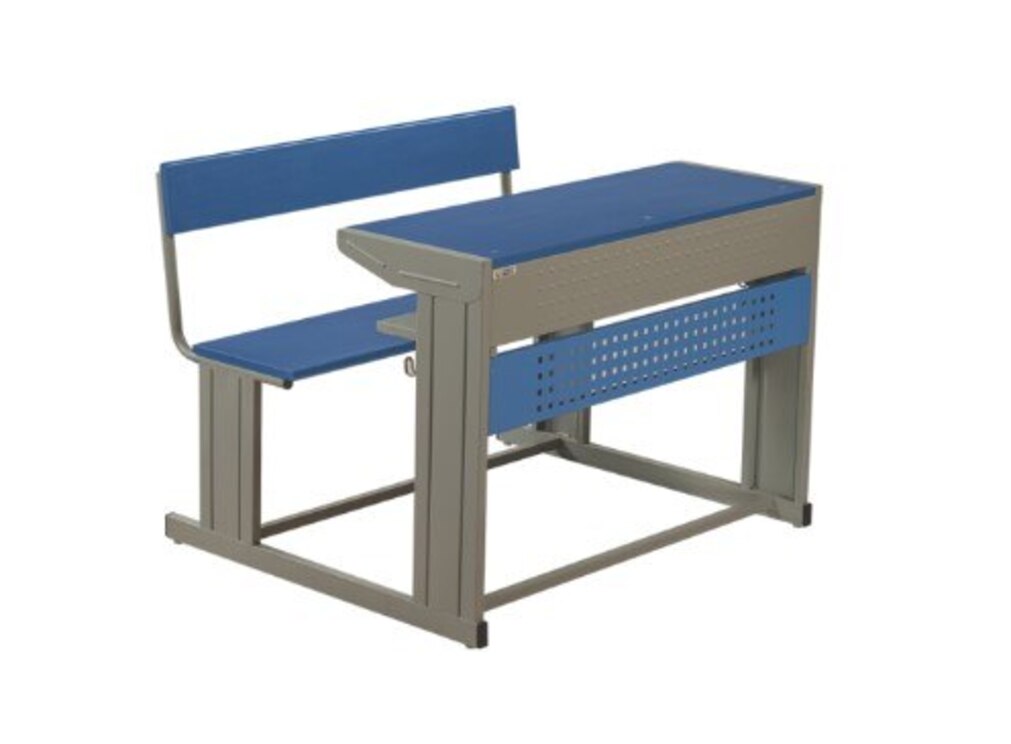
| Fixed desk-and-bench | Stable, easy to supervise and has fewer loose parts | Rearrangement is slow, and replacing one damaged seat is difficult; suited to primary classrooms with fixed rows |
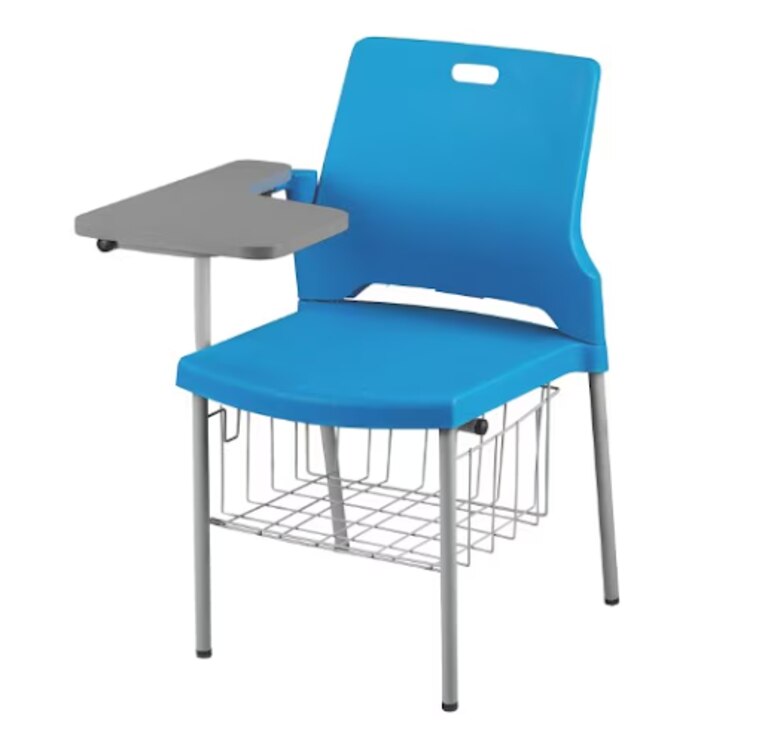
| Separate chair and desk | Easier cleaning, individual replacement and posture changes | Chairs move, drift out of alignment and require more daily straightening; useful for adult coaching and changing lesson layouts |
| Modular dual desk | Changes room layouts faster than permanently linked units | Connectors, adjustment points and inspection tasks increase; useful for computer lessons or occasional group work |
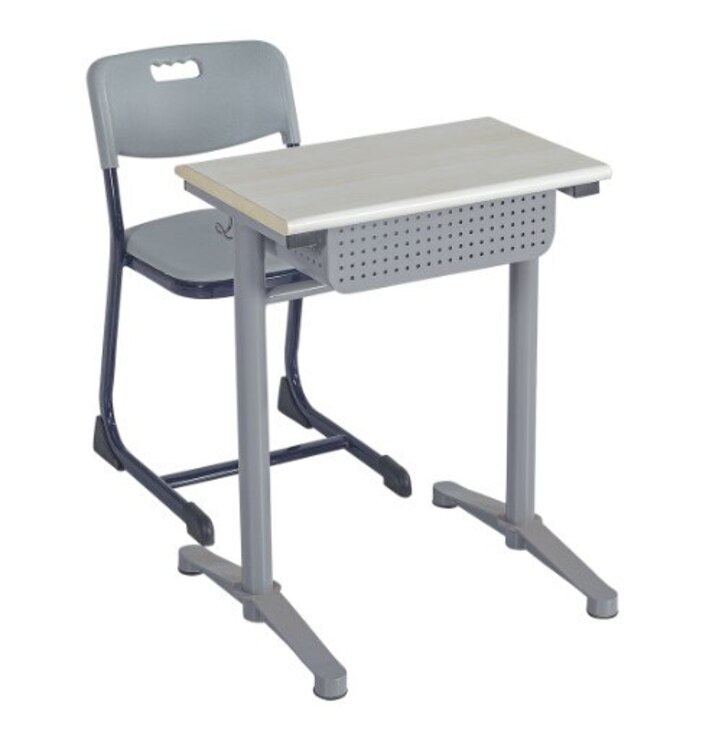
| Single-seater | Separates elbows, pairs left- and right-handed students, creates examination gaps and allows accessible placement | Uses more floor area and creates more units to move; best for examinations, students needing additional space and flexible access |
Storage changes the choice. A closed book box protects materials but can reduce knee and foot clearance; an open shelf preserves legroom yet lets bags protrude into the aisle. For School Dual Desks Sonipat, specify both storage capacity and clear foot space.
Choose fixed-height frames for lower cost and tamper resistance, stepped-height frames for defined size bands, or adjustable frames for mixed stature. Adjustment expands the fit range but adds pinch points, unequal left/right settings and maintenance checks. Inspect connectors, hinges and adjustment locks during every room change.
Turn the Specification Into a Supplier and Installation Check
Before placing an order, make the supplier prove that two pupils can use each desk comfortably and that installers can maintain it. Send a room plan, student stature bands, required EN 1729-1 size marks, clear internal dimensions, storage limits, accessibility positions and intended lesson layouts.
1. Request a drawing that identifies overall width and depth, clear elbow-to-elbow width, usable writing depth, table and seat heights, seat depth, legroom, knee and foot clearance, apron thickness, centre-frame intrusion, and book-rack width, depth and height. Ask whether each measurement is internal clearance or an outside dimension.
2. Inspect a prototype on the actual floor. Check rocking on an uneven surface, loose fasteners, weld cracking at leg-to-frame joints, sharp edges after impact, laminate lifting around screw holes and floor glides that contact evenly without sticking. Test light-reflective, low-glare surfaces, protected edges and corrosion-resistant finishes in hot classrooms.
3. Ask for assembly instructions, anchorage requirements, replacement-part availability, finish and corrosion details, stated load ratings, and applicable educational-furniture test reports, including cyclic-loading evidence. “Heavy-duty” is not a test result.
4. Require a site sample or taped mock-up before bulk production. Seat two students, test bags and lesson layouts, and walk every aisle. Record who will assemble, level and adjust each unit, including glide replacement.
For School Seating Sonipat procurement, Kantoor Furniture By 360 Degree Interiors illustrates why customized and bulk-capable manufacturing helps coordinate sizes, room-specific layouts and replacement planning; your decision still rests on documented fit, serviceability and actual seating capacity.
Related products
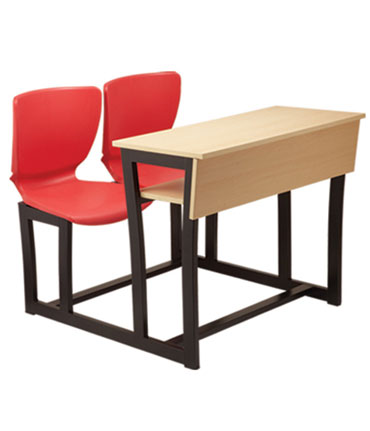 | Classroom Desk & Bench Heavy-Duty Institutional 2-Seater Modular Dual Desk & Chair Set School, College, Coaching Centre & Institutional Furniture Kantoor Furniture By 360 Degree Interiors The Heavy-Duty Institutional 2-Seater Modular... View product → |
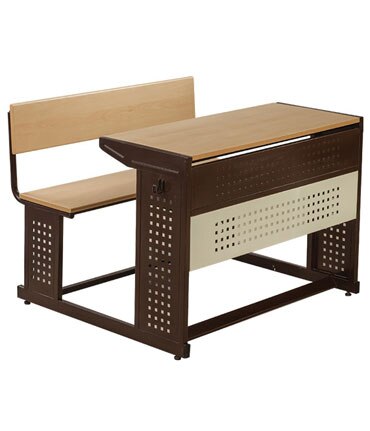 | Classroom Desk & Bench Heavy-Duty Institutional 2-Seater Classroom Dual Desk & Bench School, College & Training Institute Furniture Kantoor Furniture By 360 Degree Interiors The Heavy-Duty Institutional 2-Seater Classroom Dual Desk... View product → |
Frequently asked questions
Why should student stature guide dual-desk selection?
Measure student height and popliteal height, the floor-to-knee distance. These measurements show whether students can place their feet on the floor, keep knees below the tabletop and use the desk without awkward posture.
Which dimensions should you request from a desk supplier?
Ask for tabletop width and depth, seat width and depth, seat height, tabletop height, knee clearance, legroom, total desk footprint and the distance between the two seats. Request drawings that show each measurement.
How do you calculate the number of dual desks a classroom can hold?
Start with the usable classroom footprint, then subtract space for walls, doors, columns, storage, teacher movement and required aisles. Divide the remaining area by the complete desk footprint, including access space, rather than by tabletop size alone.
What should you check before ordering school dual desks?
Compare fixed and movable formats against cleaning, exams, group work and daily rearrangement. Confirm material specifications, edge treatment, floor protectors, delivery access, assembly, installation, replacement parts and a sample unit before bulk procurement.
Related products
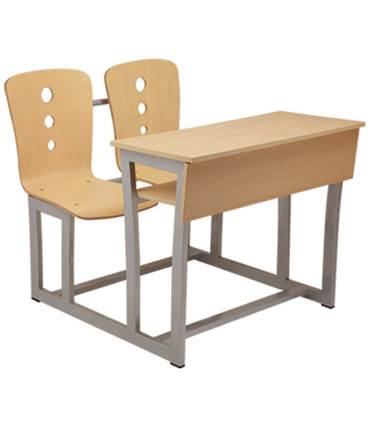 | Classroom Desk & Bench Institutional 2-Seater Modular Dual Desk & Chair Set School, College, Coaching Centre & Institutional Furniture Kantoor Furniture By 360 Degree Interiors The Heavy-Duty Institutional 2-Seater Modular... View product → |
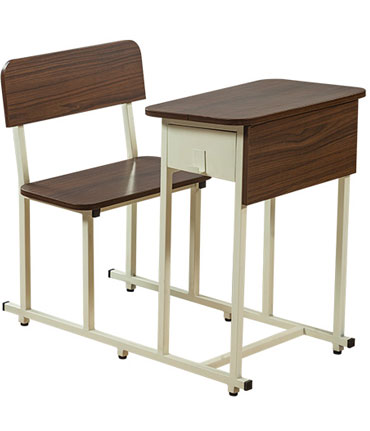 | Classroom Desk & Bench Institutional Single-Seater Student Dual Desk & Bench Classroom Furniture Supplier Delhi NCR | Student Desk with Book Rack Kantoor Furniture By 360 Degree Interiors The Institutional Single-Seater... View product → |
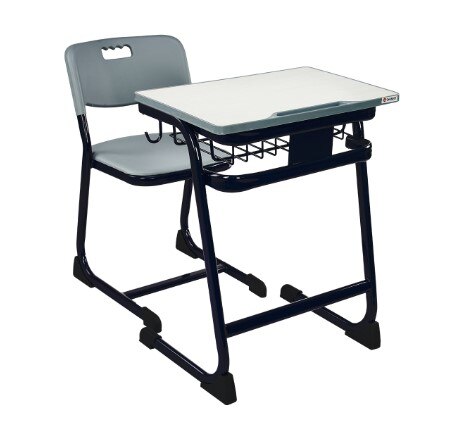 | School Desk And Training Room Chair Zumba Single-Seater School Study Desk & Chair Set Heavy-Duty Institutional Single-Seater School Study Desk & Chair Set School, College, Coaching Centre & Training Institute Furniture Kantoor... View product → |
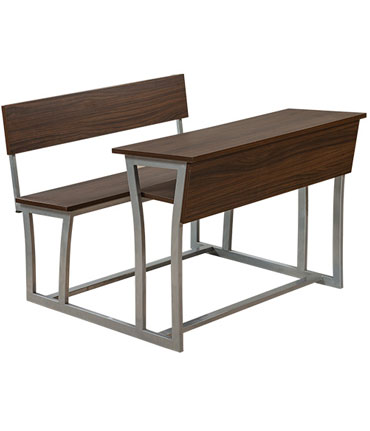 | Classroom Desk & Bench Heavy-Duty Institutional 2-Seater Student Dual Desk & Bench Durable Classroom Furniture by Kantoor Furniture By 360 Degree Interiors The Heavy-Duty Institutional 2-Seater Student Dual Desk & Bench is a durable... View product → |
Keywords