A classroom furniture manufacturer should be judged by more than labels such as modular, institutional or heavy-duty. By the end, you will have a practical method for checking factory capability, requesting verifiable specifications, testing samples, fitting furniture to students and rooms, and protecting the school through installation and after-sales terms.
Key takeaways
- Request factory evidence, production capacity and recent institutional references.
- Specify materials, dimensions, load tests, finish quality and required certificates.
- Test a sample for stability, sharp edges, comfort, cleaning and installation time.
- Put delivery dates, replacements, warranty response and spare parts in the purchase order.
How can you compare classroom furniture manufacturers beyond their product labels?
Send every classroom furniture manufacturer in Delhi NCR the same evidence pack. Require the manufacturing address, factory photographs or a site visit, production capacity, material-cutting and welding capability, powder-coating or finishing process, quality-inspection procedure, packaging method and recent institutional references. A nearby sales office does not prove factory control or local repairs.
Ask these questions directly:
- Who owns the factory, and who performs final inspection?
- Where are replacement parts stored?
- Which team installs the order, and who handles escalation?
Request design-engineering evidence for each desk and chair: a dimension schedule, exploded drawing, bill of materials, hardware list, finish schedule and permissible tolerances. The schedule must state seat height, seat depth, table height, knee clearance, tabletop size and frame dimensions. Photographs are not specifications.
Require test evidence against EN 1729-2 or an equivalent Indian specification for stability, strength, durability, moving parts, shear and pinch points, and accessible edges. Treat “heavy duty” as a label until the supplier provides the standard, load cases, report number and accredited laboratory or traceable in-house procedure.
Compare suppliers under identical headings:
| Heading | Evidence to compare |
|---|---|
| Engineering evidence | Drawings, dimensions and test reports |
| Factory capability | Capacity, cutting, welding and finishing |
| Material traceability | Batch records and supplier certificates |
| Sample performance | Full-size mock-up and signed results |
| Delivery and service | Installation method, spares and response time |
This manufacturer selection checklist creates a defensible shortlist instead of rewarding catalogue language.
Which construction specifications and certificates should the tender require?
Put the construction specification into the tender before comparing prices; otherwise a cheaper frame or thinner board can appear equivalent.
For steel frames, require the frame steel grade, tube diameter and wall thickness, weld type, weld preparation, fastener grade, pretreatment, powder-coating system and nominal coating thickness. Request adhesion, impact-resistance and corrosion-test evidence, with reports from an accredited laboratory or a traceable in-house procedure.
Inspect drilled holes, cut tube ends and welds: poor preparation at these points can start corrosion in dusty, damp or frequently cleaned NCR classrooms.
Reject “engineered wood” in the chair furniture specification. Name the board standard and thickness: IS 303 for plywood, IS 3087 for particleboard or IS 12406 for medium-density fibreboard, where applicable. Request the core construction, edge-banding specification, laminate or coating type and the certificate for the actual offered board.
Ask whether an E1 or low-formaldehyde certificate covers the finished desk, including edge banding, adhesive, laminate and coating. Require the test method, production batch, board thickness and finished-assembly status; EN 717-1 identifies a chamber method for measuring formaldehyde release from wood-based panels.
Also specify:
- Seat material, seat and back thickness, finish system, fastener access, replaceable parts and writing-surface thickness.
- EN 1729-2 evidence, or an equivalent Indian specification, covering stability, strength, durability, moving parts, shear, pinch points and accessible edges.
| Property | Tender evidence | What it proves |
|---|---|---|
| Static load | Stated vertical load and test result | Resistance to a stationary load |
| Proof load | Defined overload and load case | Margin against short-term overloading |
| Fatigue durability | Repeated-cycle test and count | Survival under daily use |
| Front or rear tipping | Separate directional stability tests | Resistance to chair tipping |
How should a school test a furniture sample before approving a bulk order?
A full-size sample, not a showroom miniature, is the basis for classroom furniture sample testing. Install it on the school’s finished flooring and inspect it with pupils, teachers, cleaners and maintenance staff who will use or handle it.
1. Push the chair from the front, side and rear as a wobble and stability test. Sit down repeatedly, check seat flex and listen for cracking. Examine backrest joints, under-seat fasteners and welds, where failures commonly begin.
2. Run your hand over every edge, underside and exposed joint. Reject sharp edges, burrs, exposed welds and other sharp edges pinch points. Open and close each hinge, drawer or storage component repeatedly, checking for finger pinch and shear points.
3. Load the writing surface with books, press near its front edge and record writing-surface deflection. Reject a top that flexes excessively, shows laminate lifting, separates at the edge band or exposes a sharp substrate.
4. Roll mobile units across tile joints and debris-prone areas. Check castor type, wheel diameter, load rating, locking behaviour and the replacement procedure; unlocked or undersized wheels can move during writing. Demand anti-tip anchoring details for tall cabinets and shelving, including substrate, anchor type, fixing points and shelf-loading limits.
Record dimensions, materials, colour, finish, hardware, weld appearance, edge treatment, tolerances and test results on a signed sample sheet. State in the purchase order that bulk furniture must match that approved record.
How do you match furniture types and dimensions to students and classroom layouts?
Fit starts with student size, teaching activity and room geometry, not one desk type for every room. Use EN 1729-1 classroom furniture dimensions as a reference for size classes, then demand a dimension schedule showing seat height and depth, desk height, knee clearance and the chair-to-desk relationship.
A mixed-size classroom may need separate sizes; primary pupils should not use furniture intended for adolescents. Test a full-size mock-up and observe feet, knees, back support and writing posture.
| Format | Advantage | Limitation or best use |
|---|---|---|
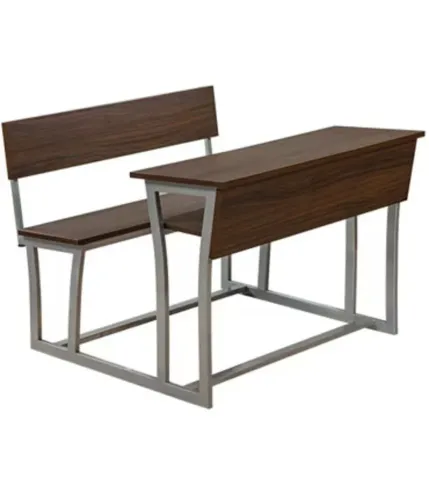
| One-seater versus two-seater dual desk | Defined workspace; easier individual assessment | Dual desks save floor area but restrict individual spacing |
| Separate desk and chair | Supports lectures, group work and examinations | Needs more storage and movement space |
| Benches | Dense seating | Less individual separation and adjustment |
| Writing-pad chairs | Fast reconfiguration for short sessions, examinations or coaching | The attached surface affects turning, left-handed use, storage and aisle width |
Draw the classroom layout at scale and check the furniture against:
- Doors, windows, columns, teacher space, storage, electrical trunking and skirting-mounted sockets.
- Circulation routes, emergency egress, door swings and ramp routes; furniture must not obstruct them.
- The 2016 Harmonised Guidelines for accessible routes and circulation. Reserve usable workstations for wheelchair users instead of filling every bay with identical two-seater desks.
- Movable furniture on the finished floor: specify castor type, wheel diameter, load rating, locking behaviour and replacement procedure. Test rolling across tile joints and debris, because unlocked or jammed wheels can disrupt writing and group work.
What should the purchase order require for delivery, installation and after-sales support?
Put delivery, installation and warranty obligations in the purchase order, not in a salesperson’s email. Make the manufacturer prove that its Delhi NCR supply chain can deliver, install and maintain the order.
1. Audit production and installation separately. Record the manufacturing address, inspection point, packaging method, delivery route, installation crew, site supervisor and escalation contact. Assign responsibility for transit damage, missing parts, rework and packaging disposal.
2. Require a full-size pilot installation on the actual classroom floor before releasing the bulk order. Use an installation acceptance checklist covering floor-level clearances, levelling, door and window conflicts, skirting, columns, sockets, colour, hardware and cable management. Obtain signed approval with photographs and room dimensions.
3. Separate the product warranty from installation and warranty and after-sales service. State the spare-parts response time, inspection time, rectification deadline, labour coverage and spare-parts period. Name the party responsible for matching panels, hinges, castors, edge banding and laminate repairs; a five-year frame warranty does not cover every failed component.
4. Require defects to be reported by room, item number and photograph, with replacement hardware and panels available for a named period. For movable furniture, specify castor diameter, load rating, locking behaviour and replacement procedure, then test it on finished school flooring.
5. Treat fire documentation as a building decision. Check the actual fire strategy, egress, flame-spread requirements and local authority conditions: educational buildings are NBC Group B, while assembly spaces are Group D. A furniture certificate is not an egress review.
Kantoor Furniture By 360 Degree Interiors can be one bidder, assessed against the same factory, pilot, installation and service evidence as every other manufacturer.
Related products
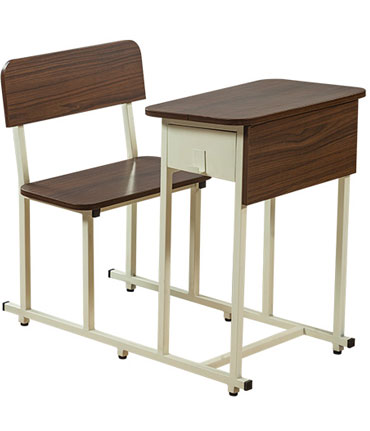 | Classroom Desk & Bench Institutional Single-Seater Student Dual Desk & Bench Classroom Furniture Supplier Delhi NCR | Student Desk with Book Rack Kantoor Furniture By 360 Degree Interiors The Institutional Single-Seater... View product → |
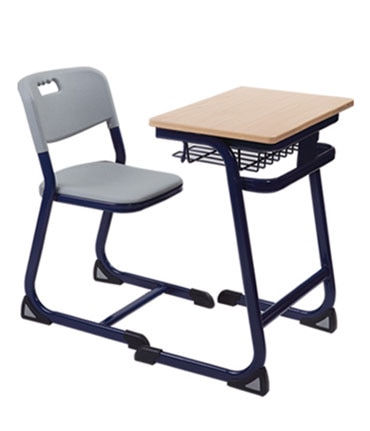 | Classroom Desk & Bench Institutional Single-Seater Modular School Desk & Chair Set School, College, Coaching Centre & Institutional Classroom Furniture Kantoor Furniture By 360 Degree Interiors The Institutional Single-Seater... View product → |
Frequently asked questions
How can a school compare classroom furniture manufacturers beyond product labels?
Send each manufacturer the same evidence pack: manufacturing address, factory photographs or site-visit access, production capacity, material-cutting and welding capability, finishing process, inspection procedure, packaging method and recent institutional references. A local sales office does not prove factory control or repair capacity.
Which construction specifications and certificates should a classroom furniture tender require?
Specify frame material and gauge, tabletop or seat-board material and thickness, joint construction, edge treatment, dimensions, load requirements, corrosion protection, finish, packaging and inspection records. Name each certificate or test report required rather than accepting a general quality claim.
How should a school test a furniture sample before approving a bulk order?
Inspect welds, fasteners, edges, moving parts, finish coverage and dimensional accuracy. Place the sample on an uneven floor, check for rocking, apply normal student loads, clean it with the products used onsite and record installation time. Approve production only after the sample matches the tender specification.
How do you match furniture types and dimensions to students and classroom layouts?
Measure student height ranges, teacher requirements, aisle widths, doorways, teaching-wall sightlines and storage needs. Select age-appropriate desk and chair dimensions, then test posture, leg clearance, reach and circulation in a full-size classroom layout.
What should a purchase order require for delivery, installation and after-sales support?
State delivery dates, quantities, packing labels, unloading responsibility, installation standards, site-readiness requirements, inspection and acceptance steps, damage reporting, replacement deadlines, warranty coverage, service response times and spare-parts availability.
Related products
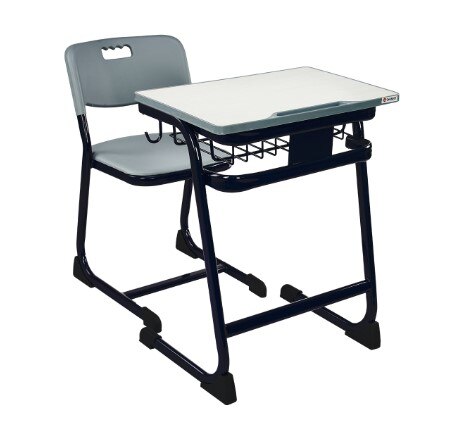 | School Desk And Training Room Chair Zumba Single-Seater School Study Desk & Chair Set Heavy-Duty Institutional Single-Seater School Study Desk & Chair Set School, College, Coaching Centre & Training Institute Furniture Kantoor... View product → |
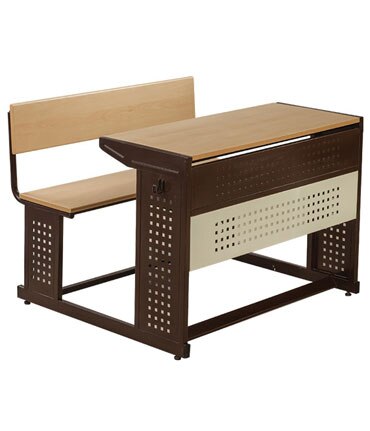 | Classroom Desk & Bench Heavy-Duty Institutional 2-Seater Classroom Dual Desk & Bench School, College & Training Institute Furniture Kantoor Furniture By 360 Degree Interiors The Heavy-Duty Institutional 2-Seater Classroom Dual Desk... View product → |
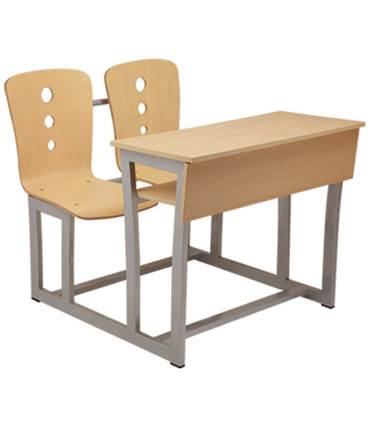 | Classroom Desk & Bench Institutional 2-Seater Modular Dual Desk & Chair Set School, College, Coaching Centre & Institutional Furniture Kantoor Furniture By 360 Degree Interiors The Heavy-Duty Institutional 2-Seater Modular... View product → |
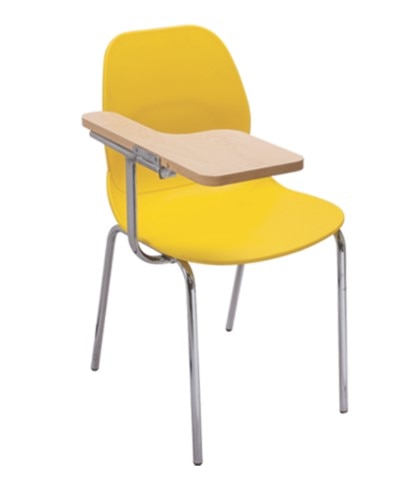 | School Desk And Training Room Chair Writing Pad Chairs for Schools, Colleges Student Desk and Chair Design for Schools, Colleges & Training Centers Premium Institutional Student & Training Room Chair Kantoor Furniture By 360... View product → |